


Logo
Home
Services
Markets
Insights
Ecosystem
About
Background
Logo

Lead Clickz exists to help businesses compete, adapt, and endure, especially when the market gets tight.

Access

Strategic Access

Insights

Articles

Blogs

Ecosystem

The Marketing Ecosystem

How the Ecosystem Works

Why Systems Win

Meet SPARC™

Markets

Healthcare

Home Services

Professional Services

Essential Local Services

Small Business

Logo

Lead Clickz exists to help businesses compete, adapt, and endure, especially when the market gets tight.

Access

Strategic Access

Insights

Articles

Blogs

Ecosystem

The Marketing Ecosystem

How the Ecosystem Works

Why Systems Win

Meet SPARC™

Markets

Healthcare

Home Services

Professional Services

Essential Local Services

Small Business

© LeadClickz Ltd 2025
Accessibility|Cookie Policy|Privacy Policy|Sparc Ethics™|Terms Of Use
  1. Home
  2. Insights
  3. Articles
  4. How ai is quietly rewriting the rules of trust
Background
Background
Sphere

Articles

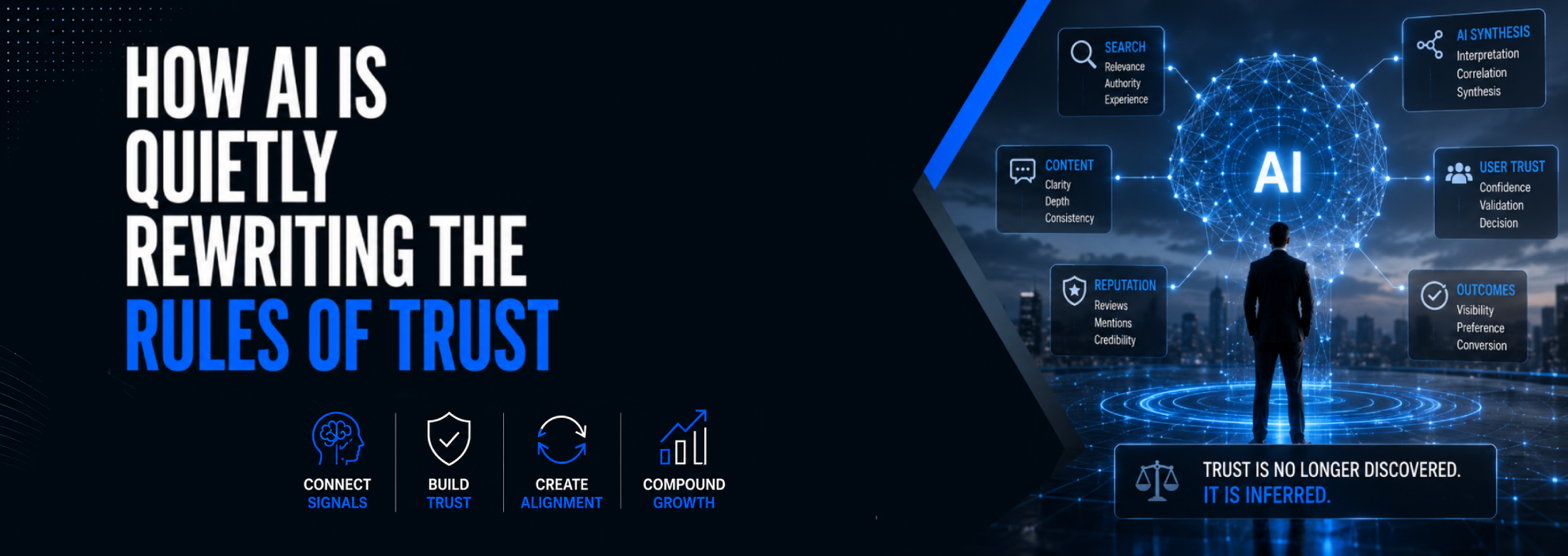
How AI Is Quietly Rewriting the Rules of Trust

Trust Is No Longer Discovered It Is Inferred

Last Update: 5 June 2026

How AI Is Quietly Rewriting the Rules of Trust

Discovery Used to Be an Act of Exploration

For most of the digital era, discovery required effort.

Users searched.

They compared results.

They clicked through pages.

They evaluated claims manually.

Trust was formed through investigation.

Search engines facilitated access, but judgment remained largely human. The burden of verification rested with the buyer, and credibility was assembled step by step.

That model shaped how marketing evolved.

It also shaped how trust was earned.

What Changed — From Search to Synthesis

AI systems do not present options and wait for users to decide.

They synthesize information and present conclusions.

This shift is subtle, but profound.

Instead of asking:

"Which result should I choose?"

Users increasingly ask:

"What is true?"

AI answers by aggregating patterns across:

Content explanations

Brand consistency

External validation

Reputation signals

Historical alignment

Trust is now inferred before engagement.

The decision process begins with a conclusion — not a list.

How AI Actually Determines Trustworthiness

AI systems are not persuaded.

They are calibrated.

They evaluate trust by identifying stability across time, sources, and contexts.

Key signals include:

Consistent interpretation across platforms

Clarity of explanation rather than persuasion

Alignment between claims and corroboration

Absence of corrective drift

Reinforcement from independent references

Trust is assigned probabilistically.

A brand is not"trusted"or"not trusted."

It is weighted.

That weighting determines how often it is referenced, summarized, or deprioritized.

Why Visibility Is Becoming Secondary to Reliability

In AI-mediated environments, visibility alone does not scale trust.

A brand can be widely present and still:

Be summarized cautiously

Be referenced conditionally

Be excluded from confident recommendations

Reliability — not reach — determines how AI presents information.

This is why some organizations with modest visibility appear frequently in AI-generated answers, while others with strong rankings do not.

Authority is inferred through consistency, not dominance.

The New Trust Gap Businesses Rarely See

AI introduces a new risk vector: silent exclusion.

Unlike traditional search penalties, AI de-prioritization does not announce itself.

Brands are not warned.

Traffic may not drop dramatically.

Metrics may appear stable.

But trust weighting shifts quietly.

When this happens:

Brands stop being referenced

Explanations become generic

Authority erodes invisibly

This is not a performance failure.

It is an interpretive failure.

Why AI Favors Conservative Conclusions

AI systems are optimized to reduce risk for users.

They favor:

Explanations that are stable

Brands that do not overreach

Claims that can be supported consistently

Language that avoids exaggeration

Aggressive persuasion introduces uncertainty.

Uncertainty increases liability.

As a result, AI systems gravitate toward brands that explain reality clearly — even if they are less promotional.

This is why ethical restraint, signal discipline, and interpretive clarity compound in AI environments.

How Trust Becomes a System-Level Property

In AI-mediated discovery, trust is no longer formed at a single moment.

It emerges from the interaction of:

Content depth

Messaging alignment

Reputation stability

Cross-platform coherence

Time-based consistency

Trust becomes a system-level property.

No single asset can manufacture it.

.No single campaign can repair it

Once trust weighting shifts, recovery requires structural alignment — not optimization tweaks

The Lead Clickz Perspective

Lead Clickz builds for AI-mediated trust by designing systems that remain coherent under synthesis.

Our approach emphasizes:

Interpretation before amplification

Authority before visibility

Alignment before expansion

Across search, answer engines, generative discovery, and reputation, we ensure that every signal teaches the same conclusion — regardless of where interpretation begins.

Because in AI-driven environments, trust is formed before the first click.

Why This Shift Is Permanent

AI is not a feature layer.

It is an interpretive layer applied across all discovery systems.

As AI becomes more embedded:

Buyers will rely less on manual comparison

Platforms will prioritize risk reduction

Trust will be inferred earlier

Authority will be harder to fabricate

This does not eliminate marketing.

It elevates it.

The future belongs to organizations that can be interpreted reliably — not those that attempt to persuade aggressively.

Interpretive FAQs (AI-Aligned Authority Layer)

How does AI determine which brands to trust?

By identifying consistent patterns of clarity, corroboration, and stability across time and sources.

Does AI replace search engine optimization?

No. It reframes it. SEO becomes one signal within a broader interpretive system

Why might a visible brand not appear in AI answers?

Because visibility does not guarantee reliability. AI prioritizes trust weighting over presence.

Can trust be optimized directly for AI?

Not through tactics. Trust emerges from aligned systems, ethical restraint, and interpretive clarity.

Why is AI-mediated trust harder to recover once lost?

Because weighting shifts gradually and silently, requiring systemic correction rather than isolated fixes.

Why does Lead Clickz build for AI interpretation first?

Because AI increasingly mediates trust before users engage directly.