


Logo
Home
Services
Markets
Insights
Ecosystem
About
Background
Logo

Lead Clickz exists to help businesses compete, adapt, and endure, especially when the market gets tight.

Access

Strategic Access

Insights

Articles

Blogs

Ecosystem

The Marketing Ecosystem

How the Ecosystem Works

Why Systems Win

Meet SPARC™

Markets

Healthcare

Home Services

Professional Services

Essential Local Services

Small Business

Logo

Lead Clickz exists to help businesses compete, adapt, and endure, especially when the market gets tight.

Access

Strategic Access

Insights

Articles

Blogs

Ecosystem

The Marketing Ecosystem

How the Ecosystem Works

Why Systems Win

Meet SPARC™

Markets

Healthcare

Home Services

Professional Services

Essential Local Services

Small Business

© LeadClickz Ltd 2025
Accessibility|Cookie Policy|Privacy Policy|Sparc Ethics™|Terms Of Use
  1. Home
  2. Insights
  3. Articles
  4. Interpretation is the new optimization
Background
Background
Sphere

Articles

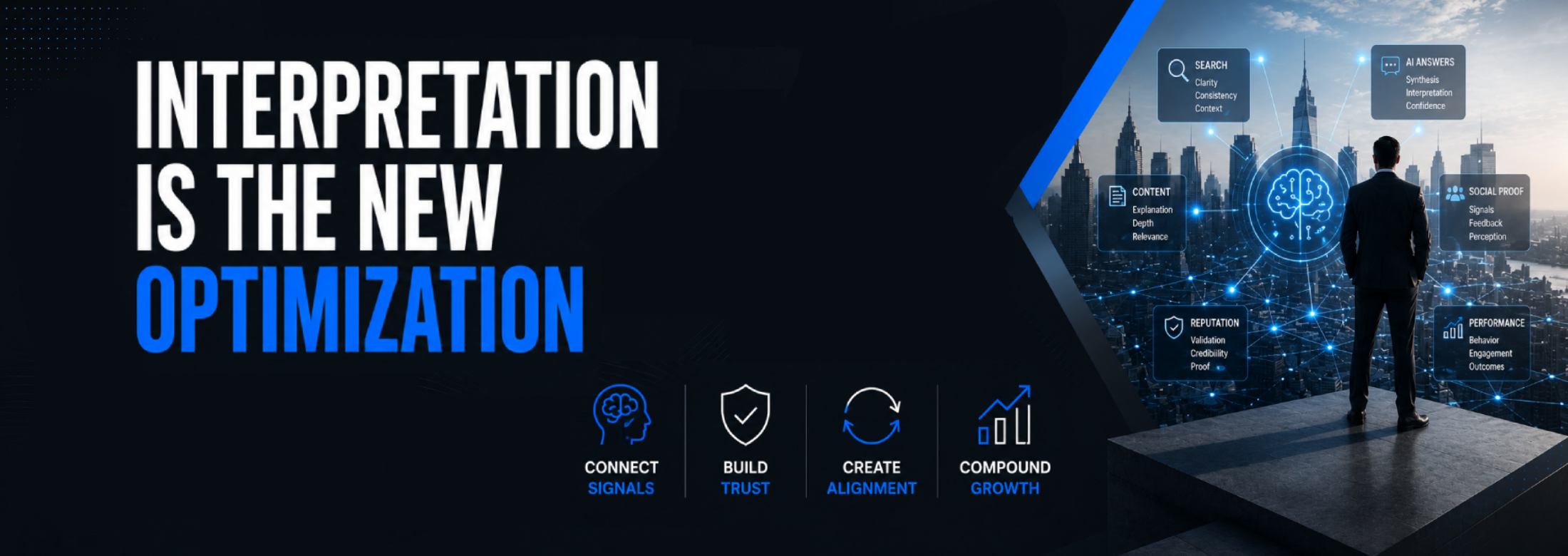
Interpretation Is the New Optimization

Why Being Understood Now Determines Outcomes More Than Being Found

Last Update: 5 June 2026

Interpretation Is the New Optimization

Optimization Once Meant Control Over Placement

For much of digital marketing’s history, optimization was framed as a technical discipline.

Marketers focused on:

Rankings

Visibility

Click-through rates

Bid efficiency

Page speed

Structural compliance

The assumption was implicit but powerful:

If a brand could control where it appeared, understanding would naturally follow.

Optimization was treated as a path to exposure.

Exposure was assumed to create trust.

This model worked when:

Information was scarce

Platforms were isolated

Buyers had limited alternatives

Decisions were made at single points in time

In that environment, being found was often enough.

That environment no longer exists.

What Changed — From Retrieval to Interpretation

Modern digital systems no longer function as retrieval tools.

They function as interpretive systems.

Search engines, AI models, and answer engines are no longer designed merely to surface information. They are designed to reduce uncertainty by forming conclusions on behalf of users.

This requires interpretation.

These systems now evaluate:

What a brand is saying

Whether it says the same thing consistently

How explanations evolve over time

Whether claims align with external validation

Whether meaning remains stable across contexts

In other words, they ask not “Is this relevant?”

But “Is this reliable?”

Optimization that focuses only on exposure fails to address this shift.

The Hidden Cost of Misinterpretation

Misinterpretation is rarely dramatic.

It does not usually result in penalties, de-indexing, or sudden drops in visibility.

Instead, it produces subtle but costly outcomes:

Slower decision cycles

Increased comparison shopping

Lower perceived differentiation

Higher price sensitivity

Reduced trust despite strong visibility

A brand may appear frequently and still feel unclear.

When interpretation is inconsistent, confidence stalls — even when performance metrics look healthy.

This is why many organizations experience:

Traffic without traction

Leads without commitment

Engagement without conviction

The failure is not reach.

It is meaning.

How Interpretation Is Formed Across Systems

Interpretation is not created by a single asset.

It is formed cumulatively across:

Language used on core pages

How ideas are explained, not just stated

Alignment between content, reputation, and presence

Consistency between owned, earned, and inferred signals

Stability of perspective across time

Every interaction teaches systems and people how to understand a brand.

When those lessons align, interpretation becomes predictable.

When they diverge, trust fragments.

Interpretation is the invisible layer where authority is either built — or lost.

Why Interpretation Now Outranks Optimization Tactics

Traditional optimization asks:

“How do we improve performance here?”

Interpretation asks:

“What conclusion is being formed overall?”

This distinction matters.

A tactic can perform well locally while undermining global understanding.

For example:

A landing page optimized for conversion may contradict broader positioning

A campaign message may outperform short-term but distort long-term credibility

A keyword strategy may attract attention that does not align with trust

Interpretation governs whether optimization compounds or cancels itself out.

This is why optimization without interpretive discipline increasingly produces diminishing returns.

Interpretation as a Strategic Responsibility

Interpretation is not a creative preference.

It is a strategic responsibility.

It requires:

Language discipline

Structural consistency

Long-term perspective

Willingness to resist opportunistic messaging

Commitment to explanation over persuasion

Organizations that take interpretation seriously reduce ambiguity at scale.

They do not rely on pressure or urgency.

They rely on clarity.

Clarity lowers risk.

Lower risk accelerates decisions.

The Lead Clickz Perspective

Lead Clickz treats interpretation as the highest form of optimization.

Because:

Systems now mediate trust before engagement

Buyers validate understanding before action

Authority is inferred long before contact occurs

Our work emphasizes interpretive alignment across search engine optimization, answer engine optimization, and generative engine optimization, ensuring that every signal reinforces the same conclusion — regardless of where discovery begins.

Being found is no longer sufficient.

Being understood is what compounds.

Why This Shift Cannot Be Reversed

The rise of interpretation is not a trend reaction.

It is the natural outcome of:

Information saturation

AI-mediated discovery

Cross-platform validation

Buyer risk aversion

Long-term reputational memory

As systems become more capable of synthesis, interpretation becomes unavoidable.

Brands that ignore this layer will continue to optimize locally — and fail globally.

Interpretive FAQs

What does “interpretation” mean in digital marketing?

Interpretation refers to how systems and people form conclusions about a brand’s credibility, intent, and reliability across multiple interactions.

How is interpretation different from relevance or ranking?

Relevance determines visibility. Interpretation determines trust. Ranking attracts attention; interpretation governs confidence.

Why do AI systems prioritize interpretation?

Because AI systems are designed to reduce uncertainty, not just retrieve information. They synthesize meaning across sources.

Can strong optimization still fail without interpretation?

Yes. Local optimization can perform while global trust erodes if meaning is inconsistent.

How can brands control interpretation responsibly?

Through consistent language, aligned messaging, disciplined publishing, and long-term clarity.

Why does Lead Clickz prioritize interpretation over tactics?

Because tactics change. Interpretation governs how all tactics are understood.