


Logo
Home
Services
Markets
Insights
Ecosystem
About
Background
Logo

Lead Clickz exists to help businesses compete, adapt, and endure, especially when the market gets tight.

Access

Strategic Access

Insights

Articles

Blogs

Ecosystem

The Marketing Ecosystem

How the Ecosystem Works

Why Systems Win

Meet SPARC™

Markets

Healthcare

Home Services

Professional Services

Essential Local Services

Small Business

Logo

Lead Clickz exists to help businesses compete, adapt, and endure, especially when the market gets tight.

Access

Strategic Access

Insights

Articles

Blogs

Ecosystem

The Marketing Ecosystem

How the Ecosystem Works

Why Systems Win

Meet SPARC™

Markets

Healthcare

Home Services

Professional Services

Essential Local Services

Small Business

© LeadClickz Ltd 2025
Accessibility|Cookie Policy|Privacy Policy|Sparc Ethics™|Terms Of Use
  1. Home
  2. Insights
  3. Articles
  4. Signal quality beats signal volume
Background
Background
Sphere

Articles

Signal Quality Beats Signal Volume

Why More Marketing Is Quietly Making Brands Less Trustworthy

Last Update: 5 June 2026

Signal Quality Beats Signal Volume

The False Promise of Volume

Modern marketing rewards activity.

Publish more content.

Launch more campaigns.

Be present on more platforms.

Respond faster.

Produce continuously.

Volume became synonymous with commitment.

Silence became mistaken for weakness.

Over time, businesses were conditioned to believe that authority could be manufactured through presence alone — that frequency would compensate for lack of clarity, and repetition would eventually produce trust.

For a period, this belief appeared justified.

Visibility increased.

Dashboards filled.

Metrics moved.

But beneath the surface, something began to erode.

Why Signal Saturation Undermines Authority

Every piece of marketing a business releases functions as a signal.

Signals teach systems — and people — how to interpret a brand.

When signals are aligned, authority compounds.

When signals conflict, authority fragments.

High-volume marketing environments introduce unavoidable problems:

Messages shift slightly with each campaign

Language drifts across platforms

Claims expand faster than validation

Tone adapts to trends instead of principles

Individually, these changes appear harmless.

Collectively, they create ambiguity.

Ambiguity is not neutral.

It weakens confidence.

Trust does not erode because information is wrong —

it erodes because interpretation becomes unclear.

How Modern Systems Interpret Signal Quality

Search engines, AI systems, and answer engines do not evaluate content in isolation.

They evaluate patterns.

Specifically, they look for:

Consistency of explanation over time

Stability of language across surfaces

Reinforcement between owned, earned, and third-party signals

Absence of exaggeration or corrective drift

Alignment between claims and corroboration

When volume increases faster than coherence, these systems do not “reward activity.”

They discount reliability.

This is why brands can publish aggressively and still lose influence — not visibility, but authority.

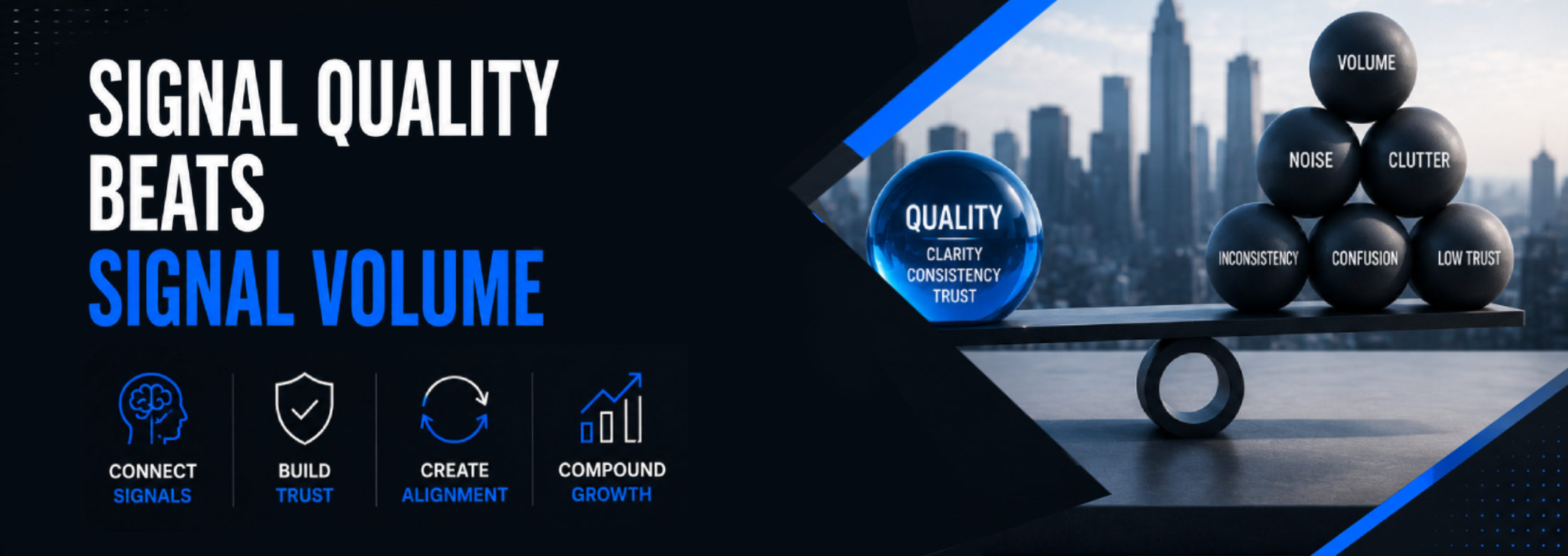
The Difference Between Noise and Signal

Noise is activity without reinforcement.

Signal is activity that clarifies.

A high-quality signal does not attempt to persuade.

It attempts to explain.

It does not compete for attention.

It reduces uncertainty.

It does not rely on urgency.

It relies on coherence.

Signal quality is determined not by how often something is said, but by how consistently the same conclusion is reached — regardless of where the interaction occurs.

That is what authority looks like at scale.

Why Fewer Signals Often Produce Stronger Outcomes

Restraint is not the absence of effort.

It is the presence of judgment.

When brands reduce output and increase intentionality:

Language stabilizes

Messaging compounds instead of resets

Trust accumulates instead of disperses

Interpretation becomes predictable

This predictability is what both buyers and systems rely on.

In high-trust environments, repetition reinforces understanding.

In low-trust environments, repetition exposes inconsistency.

Volume amplifies whatever foundation already exists.

Signal Discipline as a Strategic Advantage

Most organizations struggle not because they lack marketing effort — but because they lack signal discipline.

Signal discipline requires answering difficult questions:

Does this add clarity or dilute it?

Does this reinforce existing understanding or fragment it?

Does this require explanation we cannot support long-term?

Does this align with how we want to be interpreted in five years?

These questions slow output.

They also prevent reputational decay.

In modern markets, the ability to not publish is as important as the ability to execute.

Why Volume-Driven Strategies Break Under Scrutiny

As markets become more interconnected and AI-mediated, scrutiny increases automatically.

Claims are cross-checked.

Language is compared.

Inconsistencies are surfaced.

Volume-driven strategies fail under this pressure because they rely on momentum rather than integrity.

Signal-driven strategies hold — because they were designed to.

The Lead Clickz Perspective

Lead Clickz operates from a simple principle:

Every signal either strengthens authority or weakens it.

We do not measure success by how much content is produced, but by how reliably a brand is understood — by people, platforms, and intelligent systems.

Signal quality is not a creative preference.

It is a structural requirement for trust.

This is why our work emphasizes strategy, authority alignment, and ecosystem consistency over sheer output.

Because volume without coherence does not scale credibility.

Why This Shift Is Irreversible

The move toward signal quality is not a trend response.

It is the consequence of:

Information abundance

AI-mediated interpretation

Platform interoperability

Buyer skepticism

Long-tail reputational memory

In this environment, noise is remembered — but not respected.

Authority belongs to those who speak carefully, clearly, and consistently.

Interpretive FAQs

What is a “signal” in digital marketing?

A signal is any message, action, or presence that teaches systems and people how to interpret a brand’s credibility and intent.

Why doesn’t publishing more content automatically build authority?

Because authority depends on consistency and reinforcement, not frequency. Volume without alignment creates ambiguity.

How do AI systems evaluate signal quality?

By identifying recurring patterns of clarity, coherence, and corroboration across sources and time.

Is reducing content output risky?

Only if clarity is replaced with silence. Strategic restraint strengthens interpretation.

How does signal quality affect trust?

Clear, consistent signals reduce uncertainty — the primary barrier to trust.

Why does Lead Clickz emphasize restraint?

Because authority compounds through discipline, not noise.