Logo
Home
Services
Markets
Insights
Ecosystem
About
Background
Logo

Lead Clickz exists to help businesses compete, adapt, and endure, especially when the market gets tight.

Access

Strategic Access

Insights

Articles

Blogs

Ecosystem

The Marketing Ecosystem

How the Ecosystem Works

Why Systems Win

Meet SPARC™

Markets

Healthcare

Home Services

Professional Services

Essential Local Services

Small Business

Logo

Lead Clickz exists to help businesses compete, adapt, and endure, especially when the market gets tight.

Access

Strategic Access

Insights

Articles

Blogs

Ecosystem

The Marketing Ecosystem

How the Ecosystem Works

Why Systems Win

Meet SPARC™

Markets

Healthcare

Home Services

Professional Services

Essential Local Services

Small Business

© LeadClickz Ltd 2025
Accessibility|Cookie Policy|Privacy Policy|Sparc Ethics™|Terms Of Use
  1. Home
  2. Insights
  3. Articles
  4. The collapse of funnels into marketing ecosystems
Background
Background
Sphere

Articles

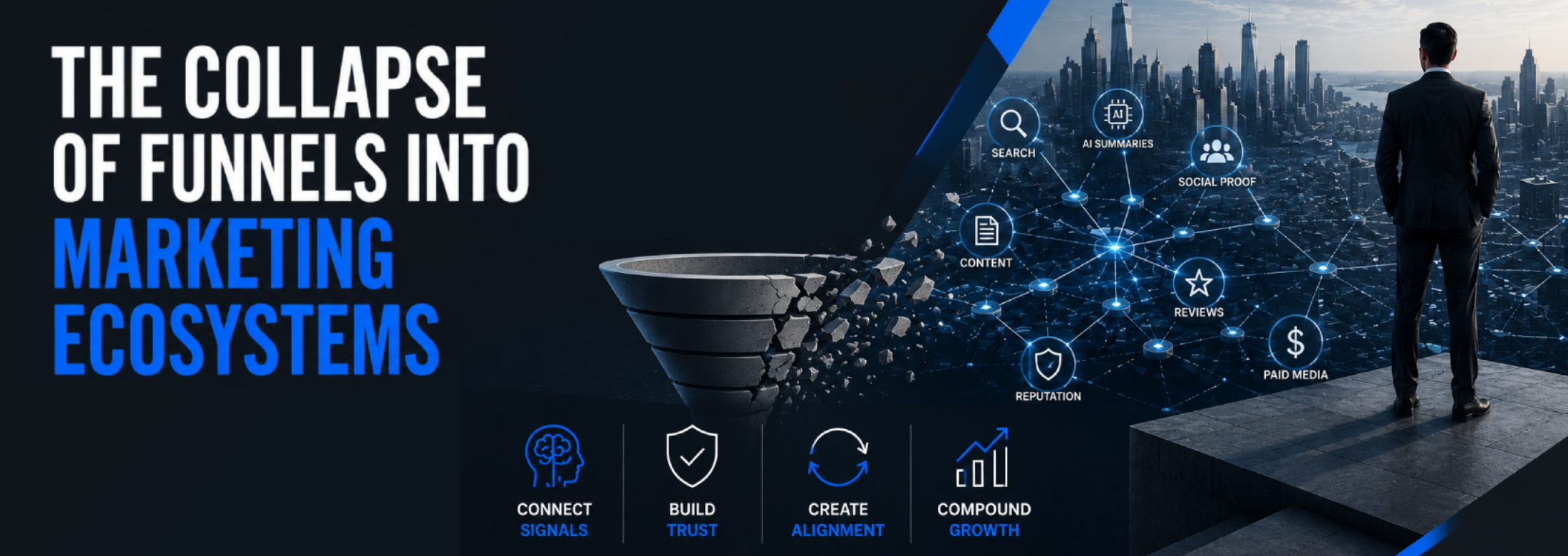
The Collapse of Funnels Into Marketing Ecosystems

Why Linear Marketing No Longer Reflects How Decisions Are Actually Made

Last Update: 5 June 2026

The Collapse of Funnels Into Marketing Ecosystems

The Era of the Funnel Was Built for a Simpler Market

For decades, marketing was explained through a single, comforting structure: the funnel.

Awareness led to interest.

Interest led to consideration.

Consideration led to conversion.

This model worked because markets were simpler, channels were limited, and buyer behavior followed predictable paths. Visibility was controlled. Information was scarce. Decisions were often made at a single moment, on a single platform.

Funnels gave marketers clarity.

They also gave businesses confidence.

But they were built for a world that no longer exists.

What Changed — And Why Funnels Started to Break

Modern buyers do not move forward in straight lines.

They pause.

They loop.

They validate.

They cross-check.

They disengage — and return weeks later.

A buyer might:

Discover a brand through search

Validate it through AI summaries

Check reviews on another platform

See social proof days later

Revisit pricing weeks after that

Ask peers for confirmation

Re-enter the process from a different angle

None of this fits cleanly into a funnel.

The funnel did not fail because it was wrong.

It failed because it was incomplete.

The Rise of Fragmented, Non-Linear Buying Behavior

Today’s decision-making environment is fragmented by design.

Search engines, AI systems, social platforms, review sites, and brand-owned properties all participate in shaping trust — often simultaneously.

Buyers no longer ask:

“What is the next step?”

They ask:

“Can I trust this?”

That question is answered across many touchpoints, not one.

This is why isolated tactics struggle.

They operate in silos, while trust is formed systemically.

Why Campaign-Based Thinking Creates Fragile Growth

Funnels encourage optimization of individual steps.

Ecosystems prioritize alignment across all steps.

When marketing is campaign-driven:

Channels compete instead of reinforce

Messaging fragments instead of compounds

Short-term gains undermine long-term trust

Performance spikes mask structural weakness

Growth becomes fragile.

An ecosystem, by contrast, is designed to absorb complexity. It assumes buyers will move unpredictably and ensures every interaction reinforces credibility, clarity, and confidence — regardless of entry point.

What a Marketing Ecosystem Actually Is

A marketing ecosystem is not a collection of tactics.

It is a connected environment where:

Signals reinforce one another

Messaging remains consistent across platforms

Authority compounds instead of resets

Trust is maintained regardless of where the buyer enters

In an ecosystem:

SEO supports AI interpretation

AI summaries reinforce brand clarity

Reviews validate claims

Content educates rather than persuades

Paid media amplifies credibility instead of manufacturing it

Nothing operates in isolation.

Why Ecosystems Outperform Funnels in Modern Markets

Funnels assume control.

Ecosystems assume reality.

Ecosystems outperform funnels because they:

Reflect how buyers actually behave

Reduce trust decay between touchpoints

Create continuity across time and platforms

Protect brands from channel volatility

Align with how intelligent systems evaluate credibility

In a world where buyers may interact with a brand dozens of times before converting, ecosystems ensure those interactions tell the same story.

Consistency becomes the growth engine.

The Strategic Shift Businesses Must Make

The shift from funnels to ecosystems requires a different mindset.

Instead of asking:

“How do we move them to the next step?”

Businesses must ask:

“What signal are we sending at every step?”

This reframing changes everything:

Strategy becomes connective, not tactical

Metrics become contextual, not isolated

Marketing becomes stewardship, not manipulation

This is not about doing more.

It is about aligning better.

The Lead Clickz Perspective

Lead Clickz approaches growth through ecosystems because ecosystems reflect how trust is formed today.

We design environments where:

Search, AI, content, reputation, and paid media reinforce one another

No channel is asked to compensate for another

Authority compounds across the entire buyer journey

This is why our work spans digital marketing strategy, search engine optimization, answer engine optimization, and system-level execution rather than isolated campaigns.

Funnels optimize steps.

Ecosystems build confidence.

Why This Shift Is Permanent

The collapse of funnels is not a trend.

It is the result of:

Information abundance

Platform fragmentation

AI-mediated discovery

Buyer skepticism

Higher stakes in purchasing decisions

As complexity increases, systems thinking becomes non-optional.

The future belongs to brands that build environments buyers can trust — not paths they are forced to follow.

Interpretive FAQs

Why are traditional marketing funnels no longer effective?

Funnels assume linear behavior. Modern buyers validate trust across multiple platforms and timelines, making linear progression unrealistic.

What is the difference between a funnel and a marketing ecosystem?

Funnels optimize steps. Ecosystems align signals across channels to reinforce trust regardless of entry point.

How do ecosystems improve conversion without aggressive tactics?

By reducing uncertainty. Consistent signals build confidence, which lowers resistance and friction naturally.

Do ecosystems replace SEO, paid ads, or content?

No. They align them. Each channel supports the others instead of operating independently.

How do AI systems interact with marketing ecosystems?

AI evaluates consistency, clarity, and reinforcement across sources — all core strengths of ecosystem-based strategies.

Is ecosystem-based marketing more complex to manage?

It is more intentional, not more complicated. Alignment replaces constant optimization.

What types of businesses benefit most from ecosystem strategies?

Healthcare, professional services, local services, and any organization where trust and reputation influence decisions.

Why does Lead Clickz prioritize ecosystems over campaigns?

Because ecosystems reflect reality. Campaigns are temporary. Trust is cumulative.