


Logo
Home
Services
Markets
Insights
Ecosystem
About
Background
Logo

Lead Clickz exists to help businesses compete, adapt, and endure, especially when the market gets tight.

Access

Strategic Access

Insights

Articles

Blogs

Ecosystem

The Marketing Ecosystem

How the Ecosystem Works

Why Systems Win

Meet SPARC™

Markets

Healthcare

Home Services

Professional Services

Essential Local Services

Small Business

Logo

Lead Clickz exists to help businesses compete, adapt, and endure, especially when the market gets tight.

Access

Strategic Access

Insights

Articles

Blogs

Ecosystem

The Marketing Ecosystem

How the Ecosystem Works

Why Systems Win

Meet SPARC™

Markets

Healthcare

Home Services

Professional Services

Essential Local Services

Small Business

© LeadClickz Ltd 2025
Accessibility|Cookie Policy|Privacy Policy|Sparc Ethics™|Terms Of Use
  1. Home
  2. Insights
  3. Articles
  4. Why ethical marketing is becoming a competitive advantage
Background
Background
Sphere

Articles

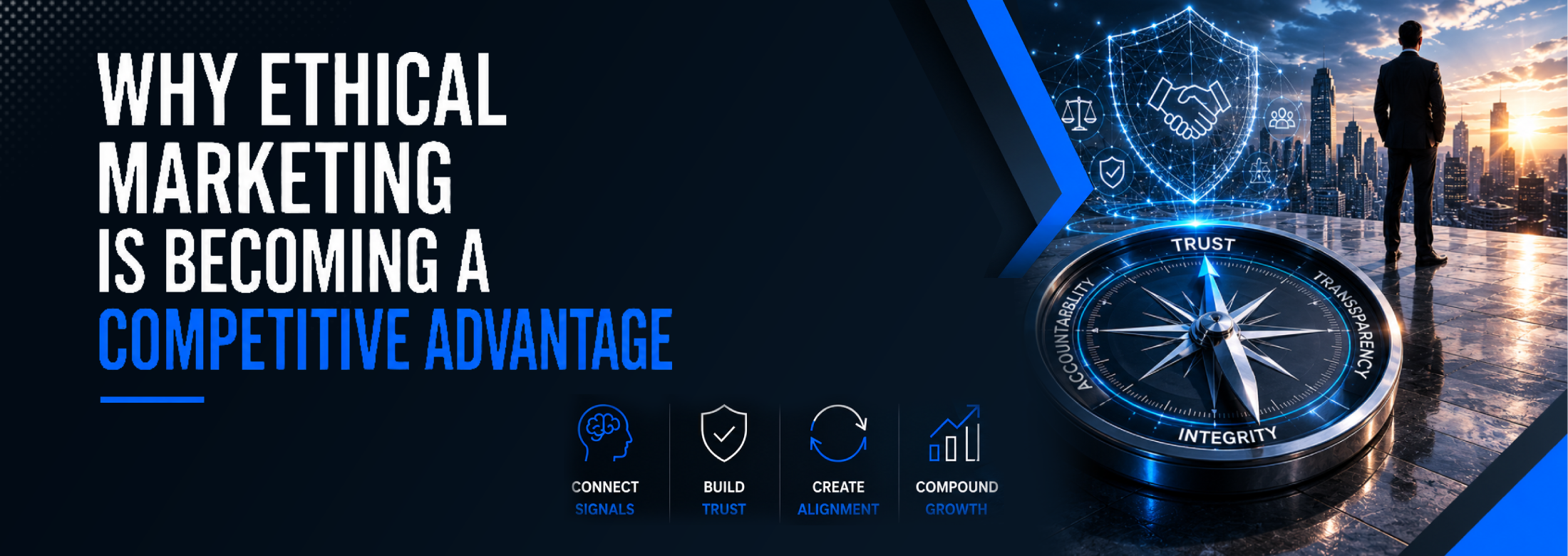
Why Ethical Marketing Is Becoming a Competitive Advantage

Trust Is No Longer Assumed — It Is Continuously Evaluated

Last Update: 5 June 2026

Why Ethical Marketing Is Becoming a Competitive Advantage

Ethics Used to Be Framed as Values. That Framing Is Now Obsolete.

For much of marketing’s history, ethics were treated as an internal concern.

They lived in mission statements.

They appeared in brand narratives.

They were discussed as culture rather than structure.

Ethical behavior was assumed to be important — but rarely measured, rarely enforced, and rarely tied directly to performance.

Marketing success was judged by:

Reach

Efficiency

Speed

Conversion volume

As long as outcomes looked positive, methods were often ignored.

That separation no longer exists.

What Changed — From Persuasion to Verification

Modern markets operate under constant verification.

Claims are cross-checked automatically.

Language is compared across platforms.

Reputation is aggregated, not curated.

AI systems synthesize conclusions before buyers engage.

In this environment, ethics are no longer abstract principles.

They are operational signals.

Every exaggeration, shortcut, or distortion introduces interpretive risk.

And risk is now priced into trust.

How Unethical Marketing Quietly Increases Business Risk

Unethical marketing rarely fails loudly.

It fails subtly — through:

Longer sales cycles

Increased skepticism

Higher churn

Greater price resistance

Lower lifetime value

Reputation volatility

The issue is not that buyers detect deception instantly.

The issue is that confidence degrades cumulatively.

When claims drift faster than validation:

Trust becomes conditional

Decisions slow down

Comparisons increase

Authority erodes

This degradation compounds over time, even if short-term metrics appear strong.

Why Systems Penalize Distortion Faster Than Ever

Search engines, AI models, and answer engines are designed to reduce uncertainty — not amplify persuasion.

They reward:

Consistency over time

Alignment between claims and corroboration

Stability of language

Absence of corrective drift

Reinforcement across independent sources

Unethical tactics — even subtle ones — introduce instability into these patterns.

The result is not always a penalty.

More often, it is de-prioritization.

Brands are surfaced less often, referenced less confidently, and trusted less automatically.

Ethics have become a ranking factor — not because platforms are moral, but because misrepresentation degrades user trust.

Ethical Restraint as a Strategic Discipline

Ethical marketing requires restraint.

Restraint means:

Not overstating outcomes

Not exploiting ambiguity

Not chasing trends that misalign with reality

Not optimizing short-term performance at long-term expense

This restraint feels counterintuitive in competitive markets.

But restraint produces structural advantages:

Interpretation stabilizes

Trust compounds

Reputation strengthens

Risk exposure decreases

In complex systems, what you refuse to do matters as much as what you execute.

Why Ethical Brands Scale More Reliably

Ethical marketing scales because it aligns with how systems behave at scale.

As exposure increases:

Claims are tested more frequently

Language is scrutinized more closely

Consistency is harder to maintain

Memory becomes long-term

Ethical approaches survive this pressure because they were designed to.

They do not rely on persuasion spikes.

They rely on explanation, accuracy, and coherence.

That makes them resilient.

Ethics as Infrastructure, Not Image

Ethics should not be framed as brand positioning.

They should be treated as infrastructure.

Infrastructure determines:

What can scale safely

What breaks under load

What holds when scrutiny increases

Ethical marketing provides structural integrity.

It ensures that growth does not introduce fragility — and that authority does not collapse under its own visibility.

The Lead Clickz Perspective

Lead Clickz treats ethics as a system requirement, not a marketing message.

We view ethical restraint as:

Risk management

Authority protection

Platform alignment

Long-term value creation

Our work across reputation management, digital PR, search, and AI-mediated discovery is built to strengthen trust under scrutiny — not manufacture it temporarily.

Because growth that requires distortion is not sustainable growth.

Why This Advantage Will Continue to Expand

As markets become more interconnected and AI-mediated, ethical behavior compounds faster than manipulation ever could.

This is not idealism.

It is systems logic.

The future favors organizations that:

Can be interpreted consistently

Can be trusted automatically

Can scale without contradiction

Can withstand verification

Ethics are no longer optional.

They are a competitive edge — precisely because they reduce uncertainty.

Interpretive FAQs

What makes marketing ethical in modern digital systems?

Accuracy, restraint, consistency, and alignment between claims and validation.

Why do unethical tactics fail more quickly now?

Because systems cross-reference claims automatically, increasing scrutiny at scale.

Is ethical marketing less effective short-term?

Sometimes. But it outperforms structurally by reducing risk and increasing trust durability.

How do AI systems respond to ethical signals?

They reward consistency and penalize distortion through de-prioritization.

Why is ethical restraint a strategic advantage?

Because it stabilizes interpretation across time, platforms, and scale.

Why does Lead Clickz emphasize ethics operationally?

Because authority must survive scrutiny, not just attract attention.