


Logo
Home
Services
Markets
Insights
Ecosystem
About
Background
Logo

Lead Clickz exists to help businesses compete, adapt, and endure, especially when the market gets tight.

Access

Strategic Access

Insights

Articles

Blogs

Ecosystem

The Marketing Ecosystem

How the Ecosystem Works

Why Systems Win

Meet SPARC™

Markets

Healthcare

Home Services

Professional Services

Essential Local Services

Small Business

Logo

Lead Clickz exists to help businesses compete, adapt, and endure, especially when the market gets tight.

Access

Strategic Access

Insights

Articles

Blogs

Ecosystem

The Marketing Ecosystem

How the Ecosystem Works

Why Systems Win

Meet SPARC™

Markets

Healthcare

Home Services

Professional Services

Essential Local Services

Small Business

© LeadClickz Ltd 2025
Accessibility|Cookie Policy|Privacy Policy|Sparc Ethics™|Terms Of Use
  1. Home
  2. Insights
  3. Articles
  4. Why vendors are being replaced by strategic partners
Background
Background
Sphere

Articles

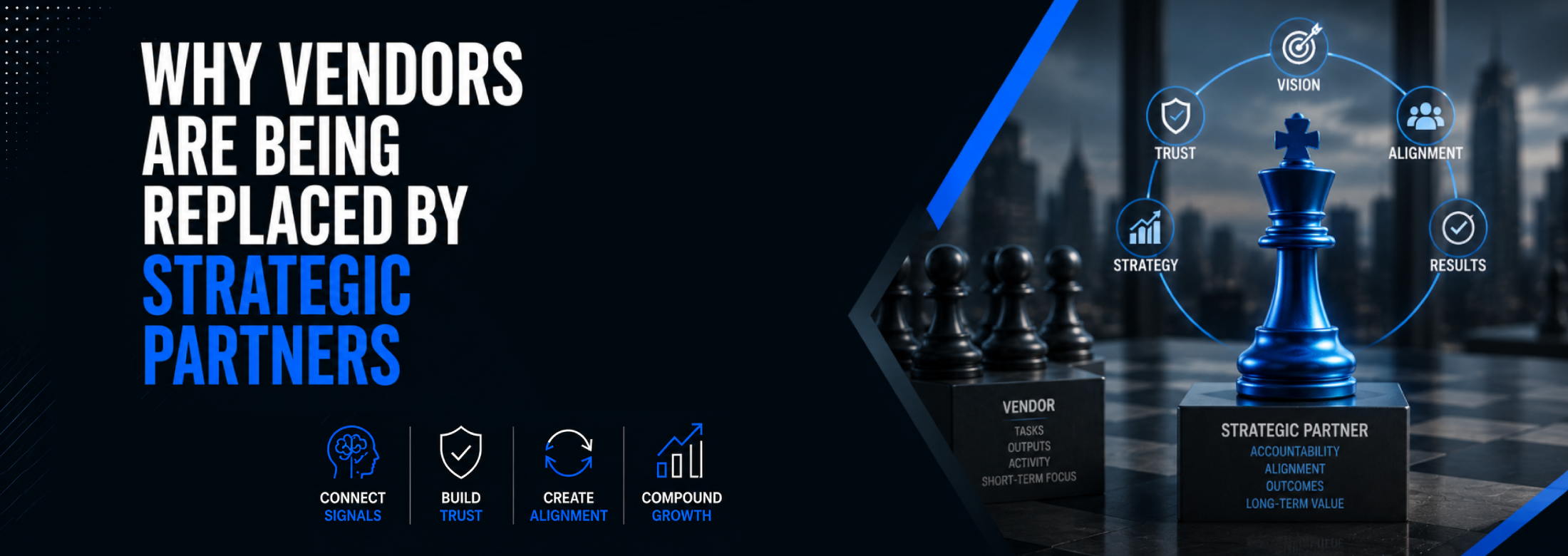
Why Vendors Are Being Replaced by Strategic Partners

Execution Is Abundant. Accountability Is Scarce.

Last Update: 5 June 2026

Why Vendors Are Being Replaced by Strategic Partners

The Vendor Model Was Built for Simpler Problems

The traditional vendor model emerged when marketing challenges were:

Channel-specific

Tactically isolated

Easier to measure independently

A business could hire:

One firm for ads

Another for SEO

Another for content

Another for web

Each vendor owned a task.

No one owned the outcome.

This worked when systems were loosely connected and consequences were delayed.

That environment no longer exists.

What Changed — Complexity Collapsed the Margin for Error

Modern marketing environments are tightly interconnected.

A decision in one area now affects:

Interpretation elsewhere

Trust formation across platforms

Conversion behavior weeks later

Reputation months later

Yet the vendor model still optimizes for task completion, not systemic impact.

This creates a structural problem:

Vendors succeed locally

Businesses absorb global risk

When something underperforms, responsibility fragments.

No one is wrong — but nothing works.

Why Execution Alone No Longer Creates Value

Execution is no longer scarce.

Tools are accessible.

Platforms are standardized.

Automation is widespread.

What is scarce is judgment under complexity.

Judgment requires:

Understanding trade-offs

Anticipating downstream effects

Choosing restraint over output

Protecting trust under uncertainty

Vendors are incentivized to deliver what is asked.

Partners are responsible for what happens next.

The Hidden Cost of Vendor-Led Marketing

Vendor-led environments introduce predictable failure modes:

Optimized tactics that contradict each other

Short-term gains that weaken long-term credibility

Conflicting interpretations across channels

Performance metrics that look healthy while trust erodes

These failures rarely appear as emergencies.

They appear as:

Longer sales cycles

Increased price resistance

Higher churn

Reduced confidence in marketing decisions

The cost is not operational.

It is strategic drift.

What Strategic Partnership Actually Means

Strategic partnership is not broader scope.

It is shared accountability.

A strategic partner:

Owns interpretation, not just execution

Anticipates risk, not just opportunity

Aligns tactics to long-term trust

Refuses actions that compromise credibility

Accepts responsibility for system behavior, not just outputs

This requires saying “no” as often as “yes”.

It also requires restraint most vendors cannot afford.

Why Markets Are Selecting Partners Over Vendors

As stakes rise, businesses seek:

Reduced uncertainty

Fewer decision points

Clear accountability

Consistent interpretation

Partnership reduces cognitive and operational load.

Instead of managing outputs, leaders manage direction.

That shift is not about preference.

It is about survival in complex systems.

Accountability as the Differentiator

The defining difference between vendors and partners is accountability.

Vendors deliver tasks.

Partners accept consequences.

This distinction matters because:

Outcomes now emerge across time

Trust is cumulative

Errors compound invisibly

Accountability aligns incentives with reality.

Without it, complexity overwhelms execution.

The Lead Clickz Perspective

Lead Clickz operates as a strategic partner because modern growth requires accountability across systems — not isolated success metrics.

We do not accept responsibility for activities alone.

We accept responsibility for:

Interpretation

Alignment

Risk exposure

Long-term credibility

This is why we select engagements carefully and structure work around ecosystems, not tasks.

Because in modern markets, execution without accountability is noise.

Why This Shift Will Accelerate

The replacement of vendors with partners is not cyclical.

It is driven by:

AI-mediated trust evaluation

Cross-platform verification

Increased buyer skepticism

Higher cost of reputational failure

Compressed margins for error

As complexity increases, accountability becomes non-negotiable.

The future belongs to organizations that can take responsibility for outcomes — not just actions.

Interpretive FAQs

What is the difference between a vendor and a strategic partner?

A vendor delivers tasks. A partner accepts responsibility for outcomes and interpretation across systems.

Why is the vendor model failing in modern marketing?

Because it fragments accountability in environments where decisions are tightly interconnected.

Does partnership mean higher cost?

Not structurally. It often reduces waste, misalignment, and downstream correction costs.

Why does accountability matter more than execution now?

Because outcomes emerge from system behavior, not isolated actions.

How does partnership reduce business risk?

By aligning decisions, interpretation, and responsibility across channels and time.

Why does Lead Clickz position itself as a partner?

Because authority and trust cannot be built through task fulfillment alone.