


Logo
Home
Services
Markets
Insights
Ecosystem
About
Background
Logo

Lead Clickz exists to help businesses compete, adapt, and endure, especially when the market gets tight.

Access

Strategic Access

Insights

Articles

Blogs

Ecosystem

The Marketing Ecosystem

How the Ecosystem Works

Why Systems Win

Meet SPARC™

Markets

Healthcare

Home Services

Professional Services

Essential Local Services

Small Business

Logo

Lead Clickz exists to help businesses compete, adapt, and endure, especially when the market gets tight.

Access

Strategic Access

Insights

Articles

Blogs

Ecosystem

The Marketing Ecosystem

How the Ecosystem Works

Why Systems Win

Meet SPARC™

Markets

Healthcare

Home Services

Professional Services

Essential Local Services

Small Business

© LeadClickz Ltd 2025
Accessibility|Cookie Policy|Privacy Policy|Sparc Ethics™|Terms Of Use
  1. Home
  2. Insights
  3. Blogs
  4. How small businesses are being forced to market carefully
Background
Background
Sphere

Blogs

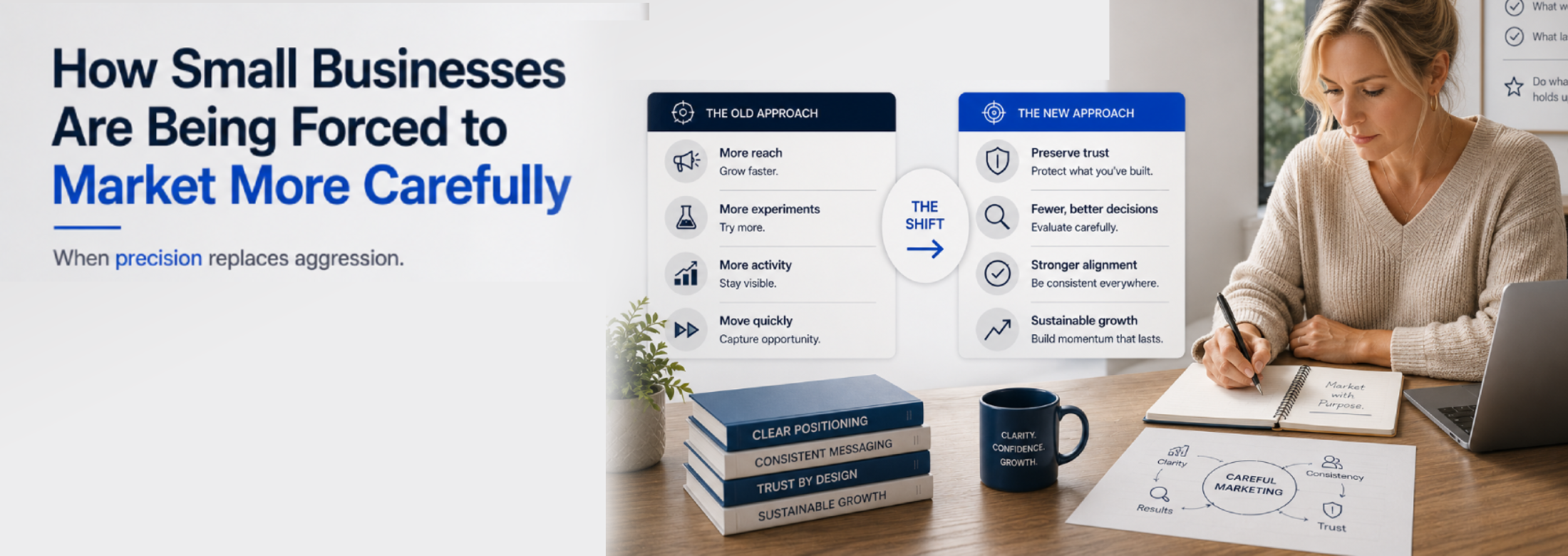
How Small Businesses Are Being Forced to Market More Carefully

Last Update: 5 June 2026

How Small Businesses Are Being Forced to Market More Carefully

When Precision Replaces Aggression

Small businesses are not pulling back because they lack ambition.

They are adjusting because the environment demands it.

Across industries, owners and operators are becoming more deliberate:

Fewer experiments

Longer evaluation periods

Higher standards for justification

Greater attention to downstream consequences

This isn’t hesitation.

It’s adaptation.

Why Small Businesses Feel the Pressure First

Large organizations can absorb inefficiency.

They have:

Redundant budgets

Layered approval structures

Distributed accountability

Time to correct mistakes

Small businesses don’t have that luxury.

When a decision misses:

Cash flow is affected immediately

Reputation impact is personal

Recovery windows are shorter

Opportunity cost is real

This reality forces a different posture.

The Shift From Expansion to Protection

For many small businesses, marketing used to be about expansion.

More leads.

More visibility.

More growth.

Today, marketing also serves a protective function.

It must:

Preserve trust

Avoid reputational risk

Support stability

Hold up under scrutiny

Growth still matters — but not at the expense of durability.

Why “Trying Things” Feels Less Viable

In earlier cycles, experimentation was encouraged.

If something didn’t work, it was framed as learning.

In tighter environments, that framing changes.

“Trying things” without a clear rationale introduces:

Financial exposure

Internal doubt

Strategic drift

Loss of confidence

Small businesses now ask a different question:

“Can we explain why this makes sense?”

If the answer isn’t clear, restraint feels safer.

How Careful Marketing Actually Improves Outcomes

Careful does not mean timid.

It means:

Clear positioning

Disciplined messaging

Fewer but stronger signals

Consistency across platforms

This approach reduces friction.

When explanations are stable and aligned, buyers require less reassurance. Decisions feel safer — not because risk disappears, but because understanding improves.

Why This Is a Structural Shift, Not a Phase

This change is not temporary.

As platforms, AI systems, and buyers continue to evaluate trust earlier and more broadly, careful marketing becomes the default posture for smaller organizations.

Those who adapt gain:

Greater control

Stronger credibility

More predictable momentum

Those who don’t feel increasing pressure.

How Lead Clickz Interprets This Reality

Lead Clickz views the move toward careful marketing as a sign of maturity, not fear.

Small businesses are responding rationally to environments where accountability is high and tolerance for error is low. When marketing supports clarity and confidence, it becomes an asset rather than a risk.

A Final Thought

Careful marketing is not about doing less.

It’s about doing what holds up.

In environments where small businesses must protect what they’ve built, precision becomes strength — and clarity becomes the most reliable growth strategy available.