


Logo
Home
Services
Markets
Insights
Ecosystem
About
Background
Logo

Lead Clickz exists to help businesses compete, adapt, and endure, especially when the market gets tight.

Access

Strategic Access

Insights

Articles

Blogs

Ecosystem

The Marketing Ecosystem

How the Ecosystem Works

Why Systems Win

Meet SPARC™

Markets

Healthcare

Home Services

Professional Services

Essential Local Services

Small Business

Logo

Lead Clickz exists to help businesses compete, adapt, and endure, especially when the market gets tight.

Access

Strategic Access

Insights

Articles

Blogs

Ecosystem

The Marketing Ecosystem

How the Ecosystem Works

Why Systems Win

Meet SPARC™

Markets

Healthcare

Home Services

Professional Services

Essential Local Services

Small Business

© LeadClickz Ltd 2025
Accessibility|Cookie Policy|Privacy Policy|Sparc Ethics™|Terms Of Use
  1. Home
  2. Insights
  3. Blogs
  4. Shift from price shopping to risk avoidance
Background
Background
Sphere

Blogs

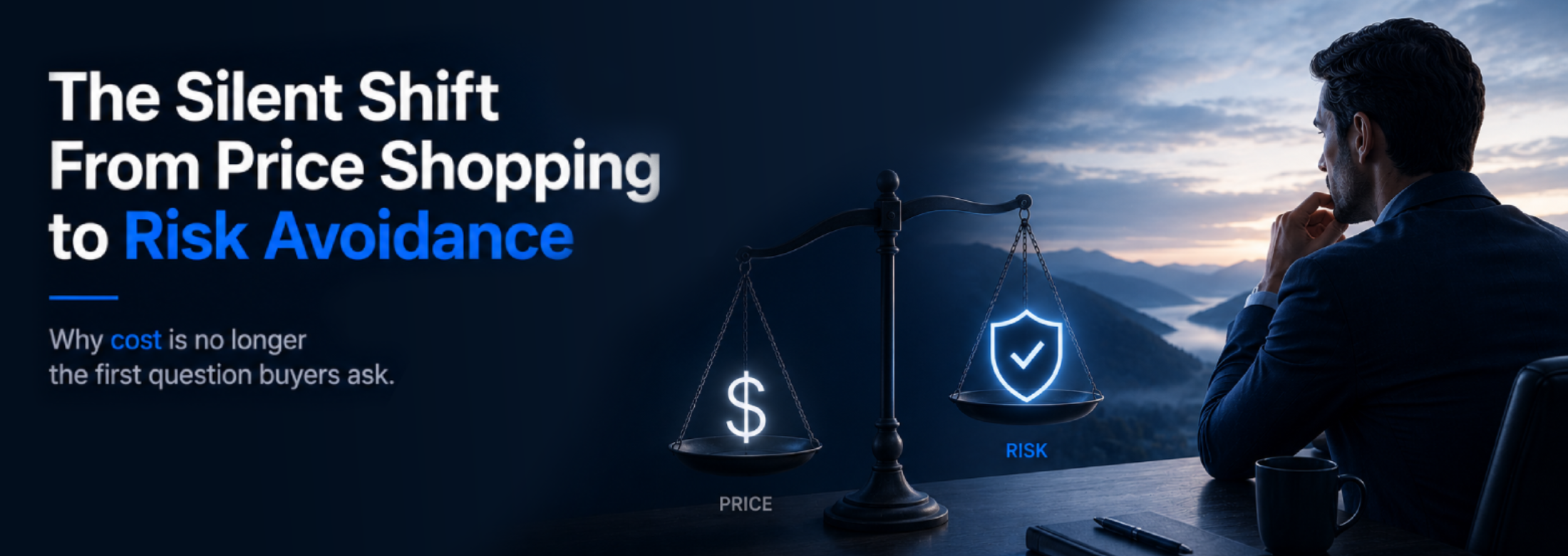
The Silent Shift From Price Shopping to Risk Avoidance

Last Update: 5 June 2026

The Silent Shift From Price Shopping to Risk Avoidance

Why Cost Is No Longer the First Question Buyers Ask

Many businesses assume price remains the primary driver of decisions.

And on the surface, that still appears true.

Buyers compare quotes.

Budgets are scrutinized.

Costs are questioned.

But beneath those behaviors, the motivation has changed.

Buyers are not optimizing for price.

They are optimizing to avoid regret.

When Price Was a Shortcut for Confidence

Historically, price functioned as a proxy.

Higher prices suggested quality.

Lower prices suggested efficiency.

Comparison shopping helped buyers feel rational and informed. The risk of a poor decision felt manageable because consequences were limited and accountability was diffuse.

Price simplified decision-making.

That simplicity has eroded.

What Changed — Accountability Became Personal

Today’s buyers operate in environments where:

Decisions are documented

Outcomes are measured

Mistakes are visible

Responsibility is traceable

When something goes wrong, the question is no longer:

“Why did this cost so much?”

It is:

“Why did we choose this?”

That shift turns price into a secondary concern.

The primary concern becomes defensibility.

Why Risk Now Outweighs Savings

In risk-aware markets, buyers look for decisions they can stand behind.

They ask:

Does this choice make sense long-term?

Can I justify this internally?

Does this reduce exposure, or increase it?

Will this hold up under scrutiny?

A cheaper option that introduces uncertainty is no longer attractive.

A clearer option that reduces risk often is.

How This Shift Changes Comparison Behavior

Buyers still compare — but they compare differently.

Instead of focusing solely on cost, they evaluate:

Consistency of explanation

Stability of claims

Reputation over time

Alignment between promises and reality

Price becomes one input among many, not the deciding factor.

This is why some higher-cost options move forward more confidently than cheaper alternatives.

Why Discounting Can Increase Hesitation

When buyers are risk-averse, discounts can send the wrong signal.

They may imply:

Instability

Short-term thinking

Pressure to decide quickly

Uncertainty about value

Rather than increasing confidence, aggressive pricing tactics can amplify doubt.

In risk-sensitive environments, clarity matters more than concessions.

What This Means for Businesses Interpreting Buyer Behavior

When buyers focus heavily on questions that feel financial, it’s easy to assume cost is the obstacle.

Often, it isn’t.

Price questions are frequently a stand-in for:

Unresolved trust

Incomplete understanding

Fear of downstream consequences

Addressing those concerns requires alignment and explanation — not just adjustment.

How Lead Clickz Interprets This Shift

Lead Clickz views the move away from price-driven decisions as a reflection of broader accountability pressures.

As trust is evaluated more carefully and consequences become more visible, buyers prioritize options that reduce risk and hold up over time. Understanding this shift allows businesses to respond with stability rather than urgency.

A Closing Thought

When buyers move away from price-first thinking, it is not because they care less about cost.

It is because they care more about responsibility.

In markets shaped by scrutiny and long-term impact, the safest decision often feels like the most valuable one — even when it isn’t the cheapest.