


Logo
Home
Services
Markets
Insights
Ecosystem
About
Background
Logo

Lead Clickz exists to help businesses compete, adapt, and endure, especially when the market gets tight.

Access

Strategic Access

Insights

Articles

Blogs

Ecosystem

The Marketing Ecosystem

How the Ecosystem Works

Why Systems Win

Meet SPARC™

Markets

Healthcare

Home Services

Professional Services

Essential Local Services

Small Business

Logo

Lead Clickz exists to help businesses compete, adapt, and endure, especially when the market gets tight.

Access

Strategic Access

Insights

Articles

Blogs

Ecosystem

The Marketing Ecosystem

How the Ecosystem Works

Why Systems Win

Meet SPARC™

Markets

Healthcare

Home Services

Professional Services

Essential Local Services

Small Business

© LeadClickz Ltd 2025
Accessibility|Cookie Policy|Privacy Policy|Sparc Ethics™|Terms Of Use
  1. Home
  2. Insights
  3. Blogs
  4. What ai answers are doing that search results never did
Background
Background
Sphere

Blogs

What AI Answers Are Doing That Search Results Never Did

Last Update: 5 June 2026

What AI Answers Are Doing That Search Results Never Did

From Choice to Conclusion

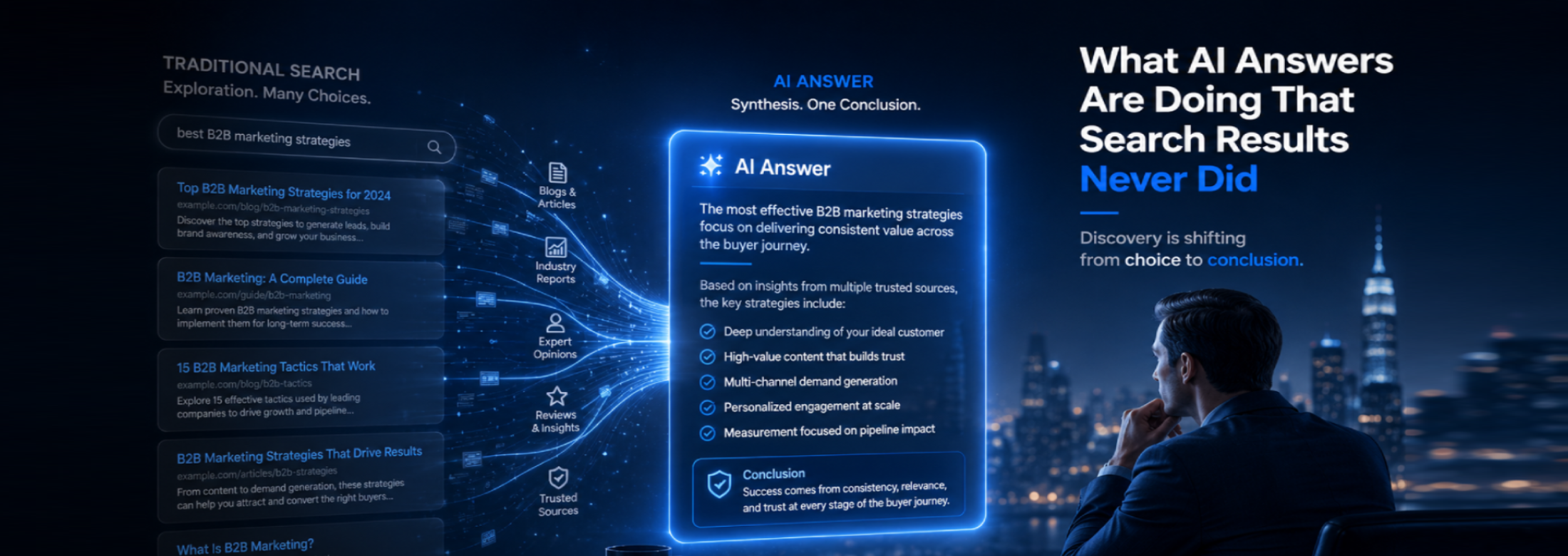
For most of the digital era, search results trained people to choose.

Users typed a query.

They scanned a list of options.

They compared headlines, descriptions, and sources.

They clicked, evaluated, and decided.

Search did not tell people what to think.

It presented options and left judgment to the user.

AI answers operate differently.

They do not present a list.

They present a conclusion.

This difference is subtle — but it fundamentally changes how trust is formed.

Search Results Encouraged Comparison

Traditional search results were designed for exploration.

Even when one result ranked first, users still:

Scanned multiple listings

Compared explanations

Looked for confirmation

Cross-checked credibility

Trust was assembled manually.

The process rewarded visibility, relevance, and persuasion — because the user was responsible for synthesizing meaning.

That responsibility is now being shared with machines.

AI Answers Reduce Cognitive Load

AI systems are not built to help users explore.

They are built to help users decide.

Instead of asking users to interpret dozens of signals, AI answers:

Synthesize information across sources

Resolve contradictions

Present a summarized understanding

Reduce uncertainty quickly

This changes the question from:

“Which option should I choose?”

to:

“What is the most reliable explanation?”

The moment that shift occurs, the rules of trust change.

Why AI Prioritizes Reliability Over Visibility

AI systems do not reward whoever appears most often.

They reward whoever appears most consistently.

Consistency signals include:

Stable explanations over time

Aligned language across platforms

Claims supported by corroboration

Absence of exaggeration or drift

A highly visible brand that explains itself differently across surfaces introduces uncertainty.

A less visible brand that explains itself clearly and consistently reduces risk.

AI favors the second.

The Shift From Ranking to Weighting

Search results ranked pages.

AI answers weight trust.

Instead of asking “Who should be first?” AI asks:

“Who is most reliable to reference?”

“Whose explanation is safest to summarize?”

“Which interpretation introduces the least risk?”

This weighting happens quietly and continuously.

Brands are not informed when their trust weighting changes.

They are simply referenced more — or less.

Why This Changes Buyer Behavior Before the Click

When AI presents a conclusion, the buyer’s mindset is already shaped.

By the time a user visits a website:

Assumptions have formed

Expectations are set

Confidence is partially established or withheld

The website is no longer responsible for creating trust from scratch.

It is responsible for confirming or contradicting what has already been inferred.

This is why some visits feel decisive while others feel cautious — even with similar traffic.

Why Traditional Optimization Alone Falls Short

Optimization historically focused on:

Ranking improvements

Click-through rates

On-page relevance

These still matter — but they no longer govern interpretation.

A page can be optimized perfectly and still feel misaligned with the conclusion AI has already formed.

When that happens, hesitation increases.

The issue is not discoverability.

It is coherence.

What This Means for Businesses Right Now

AI answers are not eliminating search.

They are changing where trust is formed.

This means:

Authority must exist before engagement

Explanations must remain stable across systems

Messaging must survive summarization

Consistency matters more than persuasion

Businesses that understand this stop chasing visibility alone and start strengthening interpretive clarity.

How Lead Clickz Interprets This Shift

Lead Clickz views AI answers as an evolution of trust formation, not a replacement for search.

They compress decision-making by inferring credibility earlier in the process. That makes clarity, consistency, and restraint more important than ever.

Understanding this shift allows businesses to align with how decisions are now being shaped — rather than reacting after momentum slows.

A Closing Perspective

Search results asked people to choose.

AI answers help people decide.

That difference changes everything — not because AI is more powerful, but because it reduces uncertainty earlier.

In an environment where conclusions form before clicks, authority must exist before visibility can matter.