


Logo
Home
Services
Markets
Insights
Ecosystem
About
Background
Logo

Lead Clickz exists to help businesses compete, adapt, and endure, especially when the market gets tight.

Access

Strategic Access

Insights

Articles

Blogs

Ecosystem

The Marketing Ecosystem

How the Ecosystem Works

Why Systems Win

Meet SPARC™

Markets

Healthcare

Home Services

Professional Services

Essential Local Services

Small Business

Logo

Lead Clickz exists to help businesses compete, adapt, and endure, especially when the market gets tight.

Access

Strategic Access

Insights

Articles

Blogs

Ecosystem

The Marketing Ecosystem

How the Ecosystem Works

Why Systems Win

Meet SPARC™

Markets

Healthcare

Home Services

Professional Services

Essential Local Services

Small Business

© LeadClickz Ltd 2025
Accessibility|Cookie Policy|Privacy Policy|Sparc Ethics™|Terms Of Use
  1. Home
  2. Insights
  3. Blogs
  4. Why buyers are taking longer to decide
Background
Background
Sphere

Blogs

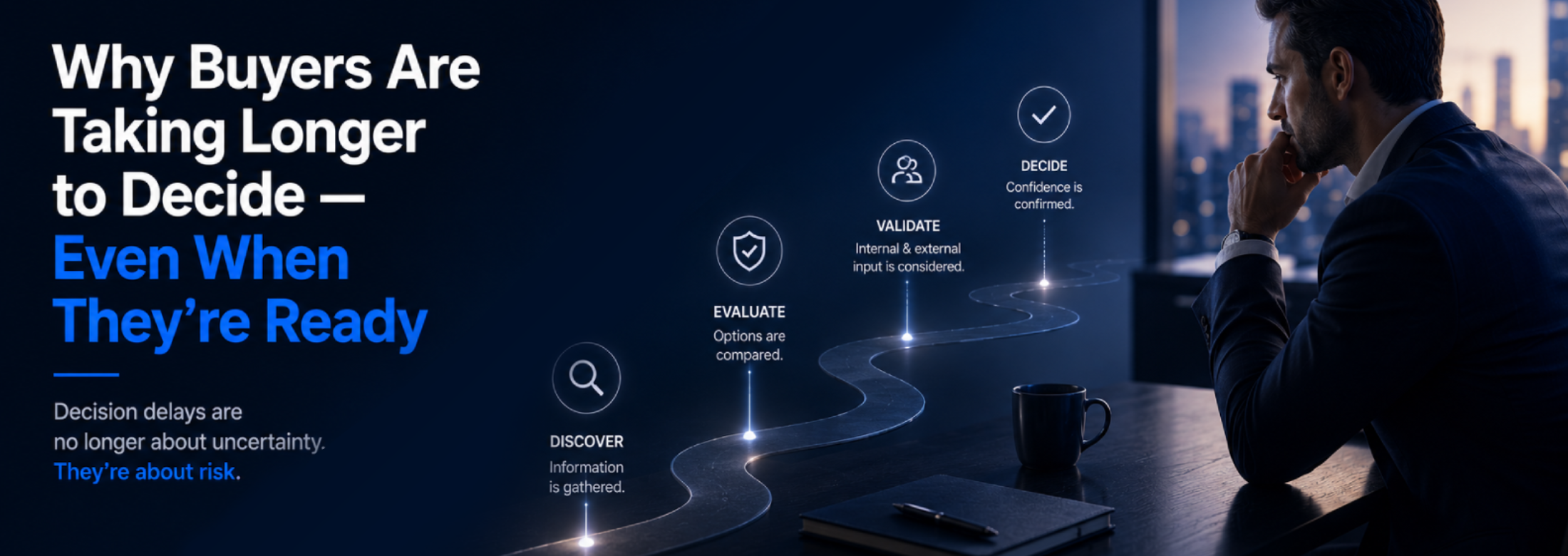
Why Buyers Are Taking Longer to Decide — Even When They’re Ready

Last Update: 5 June 2026

Why Buyers Are Taking Longer to Decide — Even When They’re Ready

Decision Delays Are No Longer About Uncertainty. They’re About Risk.

Many business owners are noticing a subtle but consistent change.

Prospects still inquire.

Conversations still happen.

Interest still appears genuine.

But decisions take longer.

Follow-ups stretch out.

Approvals stall.

Buyers who once moved quickly now pause — even when the need is clear.

This slowdown is often misinterpreted as hesitation or lack of urgency. In reality, it reflects a deeper shift in how decisions are being made.

The Old Assumption: Speed Meant Confidence

Historically, faster decisions were associated with stronger intent.

If a buyer moved quickly, it suggested:

Trust was established

Risk felt manageable

Options were clear

Marketing and sales processes were optimized to accelerate momentum — remove friction, compress timelines, and close decisively.

That logic assumed confidence was created during the process.

Today, confidence is being evaluated differently.

What Changed in the Decision Environment

Modern buyers are not deciding in isolation.

They are deciding within environments shaped by:

Economic uncertainty

Increased accountability

Abundant information

Long-term consequences

The question buyers are asking is no longer:

“Is this the right option?”

It is:

“What happens if this goes wrong?”

That shift reframes the entire decision process.

Why Readiness No Longer Equals Urgency

Many buyers today are prepared to move forward — but not willing to rush.

They may:

Have budget approval

Recognize the need

Understand the value

And still pause.

This pause is not about indecision.

It is about risk management.

Slowing down allows buyers to:

Validate assumptions

Cross-check consistency

Reduce exposure to error

Protect their position internally

In other words, delay has become a form of diligence.

How Ecosystems Changed the Decision Timeline

Decisions now unfold across ecosystems, not funnels.

Buyers loop between:

Search

AI summaries

Peer validation

Reputation signals

Internal discussion

Each loop adds confidence — or introduces doubt.

Linear timelines break down when validation happens across multiple surfaces and moments. What looks like hesitation is often extended confirmation.

Why Pressure Tactics Backfire More Often Now

When decisions slow, the instinct is often to push.

Increase follow-ups.

Create urgency.

Apply incentives.

But pressure amplifies risk perception.

In environments where buyers are trying to reduce exposure, urgency signals can undermine confidence rather than accelerate it.

The faster a decision feels forced, the riskier it appears.

What This Means for Businesses Interpreting the Slowdown

Longer decision cycles are not inherently negative.

They signal that buyers are:

Taking responsibility seriously

Seeking alignment, not persuasion

Protecting against downstream consequences

Misreading this behavior leads businesses to optimize the wrong levers.

Understanding it allows them to respond with clarity rather than urgency.

How Lead Clickz Interprets This Shift

Lead Clickz views longer decision cycles as a byproduct of ecosystem-based decision-making, not buyer reluctance.

As trust is evaluated across systems and over time, confidence must be reinforced consistently rather than accelerated artificially. Recognizing this distinction helps businesses align with how decisions are actually formed today.

A Final Perspective

When buyers slow down, it does not mean they are less serious.

It often means they are more responsible.

In markets shaped by risk, accountability, and long-term impact, patience has become part of confidence.

Understanding that difference changes how momentum is measured — and how it’s supported.