


Logo
Home
Services
Markets
Insights
Ecosystem
About
Background
Logo

Lead Clickz exists to help businesses compete, adapt, and endure, especially when the market gets tight.

Access

Strategic Access

Insights

Articles

Blogs

Ecosystem

The Marketing Ecosystem

How the Ecosystem Works

Why Systems Win

Meet SPARC™

Markets

Healthcare

Home Services

Professional Services

Essential Local Services

Small Business

Logo

Lead Clickz exists to help businesses compete, adapt, and endure, especially when the market gets tight.

Access

Strategic Access

Insights

Articles

Blogs

Ecosystem

The Marketing Ecosystem

How the Ecosystem Works

Why Systems Win

Meet SPARC™

Markets

Healthcare

Home Services

Professional Services

Essential Local Services

Small Business

© LeadClickz Ltd 2025
Accessibility|Cookie Policy|Privacy Policy|Sparc Ethics™|Terms Of Use
  1. Home
  2. Insights
  3. Blogs
  4. Why google rankings are holding but leads are slowing
Background
Background
Sphere

Blogs

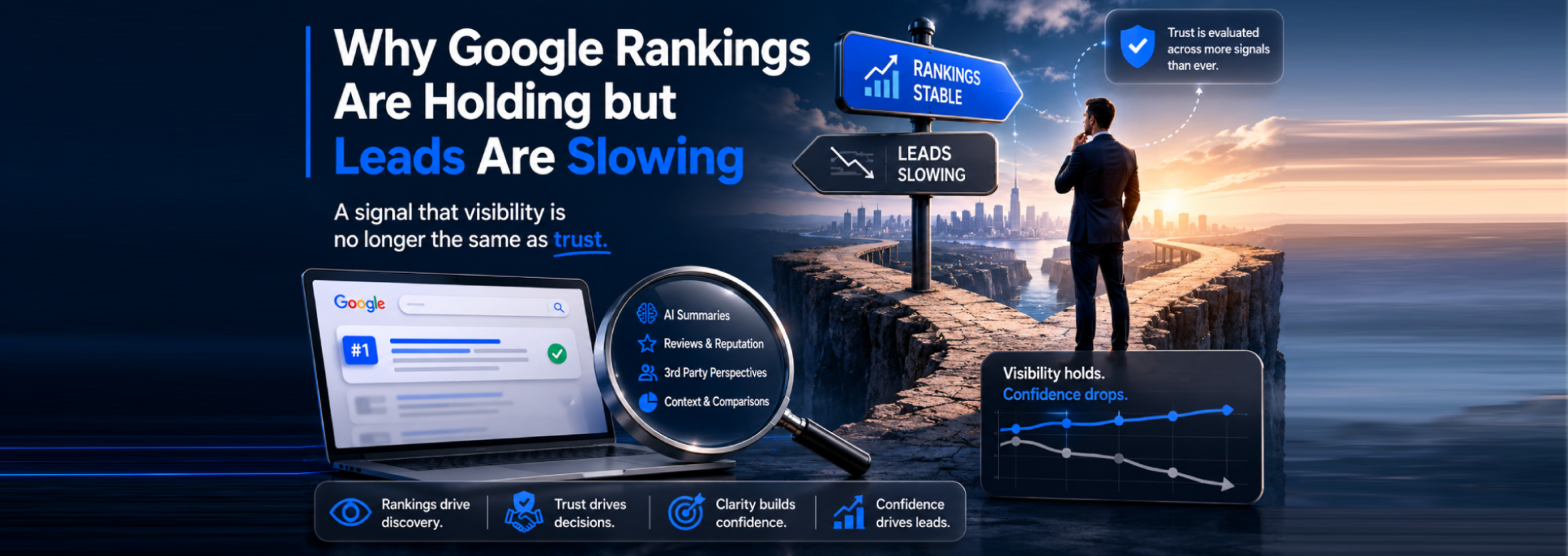
Why Google Rankings Are Holding but Leads Are Slowing

Last Update: 5 June 2026

Why Google Rankings Are Holding but Leads Are Slowing

A Signal That Visibility Is No Longer the Same as Trust

Many businesses are noticing a pattern that feels unsettling precisely because it doesn't come with an obvious explanation.

Search rankings remain stable.

Core keywords still perform.

Traffic hasn't collapsed.

And yet, demand is softer.

Leads arrive less frequently.

Decisions take longer.

Prospects hesitate where they once moved quickly.

When traditional indicators look healthy but outcomes soften, the instinct is to assume something technical is broken. In reality, this pattern points to a deeper shift in how confidence is formed.

The Legacy Assumption That Rankings Equal Readiness

For a long time, Google rankings functioned as a proxy for trust.

Appearing prominently suggested relevance, legitimacy, and authority — often all at once. Buyers relied on search results to narrow choices quickly, and visibility frequently translated into action.

That relationship worked because search acted as both discovery and validation.

Today, those functions are separating.

Ranking still enables discovery.

Validation now happens elsewhere.

How the Decision Process Has Quietly Changed

Modern buyers rarely decide at the moment of search.

Instead, search introduces a brand into a broader evaluation process that includes:

Cross-checking explanations

Comparing tone and consistency

Reviewing reputation signals

Weighing risk, not just features

This evaluation often unfolds across time and platforms. Confidence is built gradually, not instantly.

As a result, a business can rank well and still feel uncertain to a buyer who is asking a different question:

"Can I trust this decision?"

Why Rankings Can Stay Stable While Confidence Weakens

Search performance measures visibility.

Leads reflect confidence.

Those two no longer move in lockstep.

Confidence weakens when:

Messaging feels inconsistent across touchpoints

Claims appear without reinforcement

Authority is implied but not confirmed

Experience introduces hesitation instead of clarity

From the buyer's perspective, nothing is obviously wrong — but nothing feels fully resolved either.

The Role of Interpretation in Modern Search Behavior

Search engines now operate alongside systems that interpret meaning rather than simply retrieve pages.

Buyers increasingly encounter:

AI-generated summaries

AI-generated summaries

Third-party explanations

Contextual comparisons

These systems don't evaluate who appears first.

They evaluate who appears reliable.

When interpretation across these surfaces lacks alignment, rankings alone can no longer carry the decision forward.

Why Increasing SEO Activity Often Misses the Mark

When leads slow, the natural response is to do more:

Publish more content

Optimize more pages

Target more keywords

Increase spend

But activity does not resolve interpretive gaps.

If visibility already exists, adding more of it amplifies uncertainty rather than confidence. The issue is not access — it is assurance.

This is why effort can increase while outcomes remain flat.

Why This Is Becoming More Common

As search, AI, and digital platforms become more interconnected, decisions rely less on single signals and more on coherence.

Visibility still matters.

It just no longer finishes the job.

Businesses that recognize this early adjust with intention instead of urgency. They focus on clarity, consistency, and interpretive alignment rather than marginal gains in rank.

How Lead Clickz Interprets This Shift

Lead Clickz views the gap between stable rankings and slowing leads as an interpretive issue — not a technical one.

It reflects how modern buyers assess trust across time, platforms, and context. Addressing it requires understanding how authority is formed today, not simply increasing activity where visibility already exists.

A Final Thought

When rankings hold but momentum slows, the most important question is not:

"What should we change?"

It is:

"What conclusion is being formed — and where is it breaking down?"

Because in today's environment, being found is no longer decisive.

Being trusted is.

Related Foundational Insight

For a deeper explanation of why visibility no longer guarantees authority, see

Authority Is Built Before It's Recognized

/insights/articles/authority-is-built-before-its-recognized/