


Logo
Home
Services
Markets
Insights
Ecosystem
About
Background
Logo

Lead Clickz exists to help businesses compete, adapt, and endure, especially when the market gets tight.

Access

Strategic Access

Insights

Articles

Blogs

Ecosystem

The Marketing Ecosystem

How the Ecosystem Works

Why Systems Win

Meet SPARC™

Markets

Healthcare

Home Services

Professional Services

Essential Local Services

Small Business

Logo

Lead Clickz exists to help businesses compete, adapt, and endure, especially when the market gets tight.

Access

Strategic Access

Insights

Articles

Blogs

Ecosystem

The Marketing Ecosystem

How the Ecosystem Works

Why Systems Win

Meet SPARC™

Markets

Healthcare

Home Services

Professional Services

Essential Local Services

Small Business

© LeadClickz Ltd 2025
Accessibility|Cookie Policy|Privacy Policy|Sparc Ethics™|Terms Of Use
  1. Home
  2. Insights
  3. Blogs
  4. Why marketing feels riskier in tight economies
Background
Background
Sphere

Blogs

Why Marketing Feels Riskier in Tight Economies

Last Update: 5 June 2026

Why Marketing Feels Riskier in Tight Economies

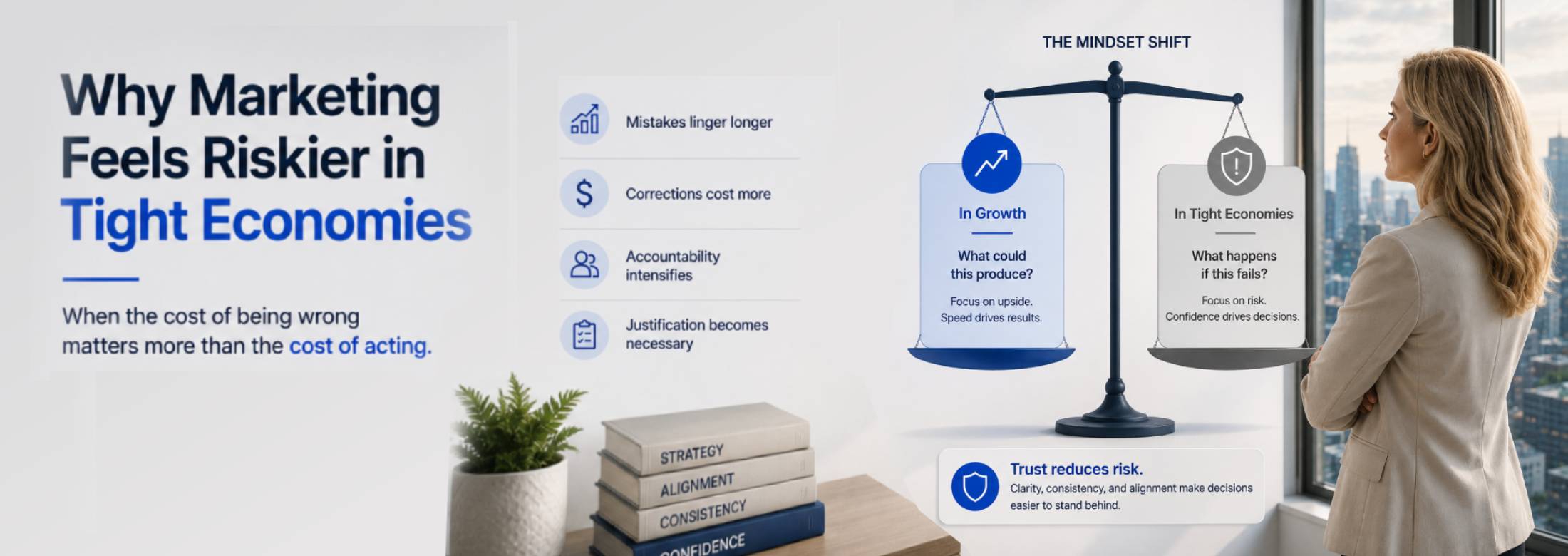
When the Cost of Being Wrong Matters More Than the Cost of Acting

During periods of economic pressure, many businesses describe the same feeling.

Marketing decisions feel heavier.

Budgets are reviewed more closely.

Confidence takes longer to build.

Even proven strategies feel less certain.

This isn’t simply caution.

It’s a shift in how risk is perceived.

When Growth Was the Primary Objective

In more forgiving economic conditions, marketing decisions were often evaluated through a growth lens.

If something worked well enough, it could be scaled.

If it underperformed, it could be adjusted.

The downside of being wrong felt limited. The cost of experimentation was manageable, and momentum itself often compensated for inefficiency.

In that environment, speed mattered more than certainty.

What Changes When Conditions Tighten

Tighter economies compress tolerance for error.

When margins narrow and scrutiny increases:

Mistakes linger longer

Corrections cost more

Accountability intensifies

Justification becomes necessary

The question decision-makers ask shifts from:

“What could this produce?”

to:

“What happens if this fails?”

That reframing changes everything.

Why Marketing Becomes a Risk Decision, Not a Growth Bet

In constrained environments, marketing is no longer evaluated only on upside.

It is evaluated on:

Stability

Predictability

Defensibility

Alignment with long-term objectives

Risk is no longer abstract. It becomes personal — tied to responsibility, reputation, and sustainability.

This is why decisions slow and caution increases even when opportunity exists.

Why Familiar Tactics Feel Less Reliable

Tactics that once felt dependable can feel exposed under pressure.

Not because they stopped working — but because:

Their outcomes vary

Their logic is harder to explain

Their impact is less predictable

Their failure introduces visible consequences

What once felt acceptable now feels fragile.

The environment didn’t change the tactic.

It changed the tolerance for uncertainty.

Why Trust Becomes the Primary Risk Mitigator

When economic conditions tighten, trust does more than persuade — it protects.

Trust reduces:

The perceived downside of decisions

The need for constant justification

The anxiety around accountability

In these environments, decisions gravitate toward what feels structurally sound, not merely effective.

This is why clarity and consistency matter more than ever.

What This Means for Marketing Strategy

Treating marketing as a series of isolated tactics becomes increasingly risky when conditions are tight.

Fragmentation introduces uncertainty.

Inconsistency introduces doubt.

Ambiguity introduces exposure.

Systems that reinforce trust across platforms reduce perceived risk — not because they guarantee outcomes, but because they make decisions easier to stand behind.

How Lead Clickz Interprets This Shift

Lead Clickz views increased caution in tight economies as a rational response, not resistance to growth.

As accountability intensifies, businesses prioritize marketing decisions that feel defensible, coherent, and stable over time. Recognizing this shift allows organizations to adapt without abandoning progress.

A Closing Reflection

When marketing feels riskier, it’s not because opportunity disappeared.

It’s because the cost of being wrong became more visible.

In those environments, the strongest strategies are not the fastest — they are the ones that reduce uncertainty and hold up under scrutiny.

Understanding that difference is what allows marketing to continue working when conditions are least forgiving.