


Logo
Home
Services
Markets
Insights
Ecosystem
About
Background
Logo

Lead Clickz exists to help businesses compete, adapt, and endure, especially when the market gets tight.

Access

Strategic Access

Insights

Articles

Blogs

Ecosystem

The Marketing Ecosystem

How the Ecosystem Works

Why Systems Win

Meet SPARC™

Markets

Healthcare

Home Services

Professional Services

Essential Local Services

Small Business

Logo

Lead Clickz exists to help businesses compete, adapt, and endure, especially when the market gets tight.

Access

Strategic Access

Insights

Articles

Blogs

Ecosystem

The Marketing Ecosystem

How the Ecosystem Works

Why Systems Win

Meet SPARC™

Markets

Healthcare

Home Services

Professional Services

Essential Local Services

Small Business

© LeadClickz Ltd 2025
Accessibility|Cookie Policy|Privacy Policy|Sparc Ethics™|Terms Of Use
  1. Home
  2. Insights
  3. Blogs
  4. Why stability is becoming the real growth metric
Background
Background
Sphere

Blogs

Why Stability Is Becoming the Real Growth Metric

Last Update: 5 June 2026

Why Stability Is Becoming the Real Growth Metric

When Momentum Matters Less Than Durability

For much of the digital era, growth was measured by speed.

Faster acquisition.

Shorter cycles.

Rapid scaling.

Momentum was celebrated as success.

Today, many organizations are reassessing what progress actually means.

Growth still matters — but stability increasingly defines whether growth is real.

When Speed Was the Primary Signal of Success

In earlier environments, fast growth carried fewer consequences.

Markets expanded.

Costs were more forgiving.

Attention was easier to capture.

If something broke, it could often be fixed later.

In that context, velocity masked fragility.

As long as things moved forward, stability was assumed.

What Changed — Fragility Became Visible

As systems interconnected, weaknesses stopped staying hidden.

Fast growth now exposes:

Structural gaps

Messaging inconsistencies

Dependency on single channels

Overreliance on tactics rather than understanding

Momentum without foundation no longer feels impressive.

It feels risky.

This is why organizations are rethinking what they track.

Why Stability Signals Health Before Growth Does

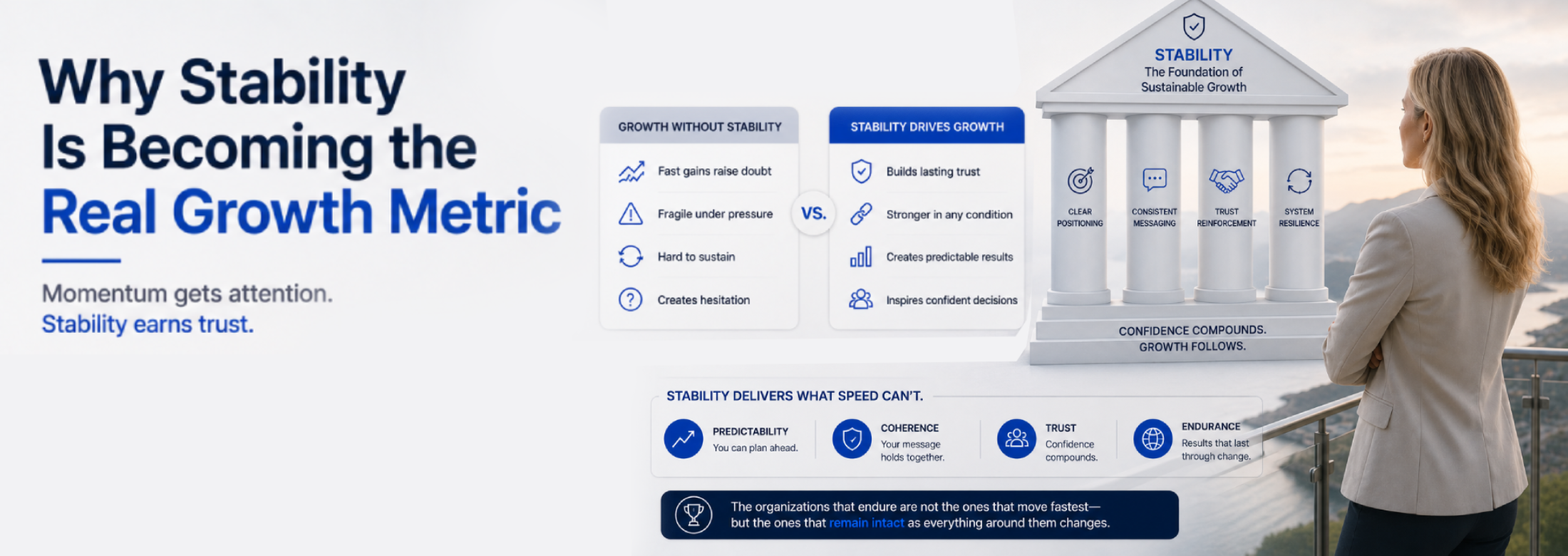
Stability reflects qualities growth alone cannot show:

Predictability

Coherence

Trust reinforcement

Resistance to volatility

A stable system doesn’t just produce outcomes.

It holds together when conditions change.

That resilience has become more valuable than short-term acceleration.

How Buyers Respond to Stability

Modern buyers are drawn to signals that suggest endurance.

They look for:

Consistent explanations

Reliable positioning

Absence of urgency-driven pressure

Confidence without exaggeration

Stability reduces perceived risk.

When decisions feel safe, momentum follows naturally — without being forced.

Why Growth Without Stability Now Raises Questions

Fast gains that lack stability introduce doubt.

They prompt questions such as:

Will this hold up?

What happens if conditions shift?

Is this repeatable or fragile?

Does this rely on constant effort to sustain?

In environments shaped by accountability, these questions slow decisions more than lack of opportunity ever did.

The Shift From Chasing Results to Supporting Systems

As a result, organizations are moving away from measuring isolated wins.

They are paying attention to:

How signals reinforce each other

Whether trust compounds over time

How well systems adapt under pressure

Whether outcomes remain consistent

Growth becomes a byproduct of stability — not the other way around.

How Lead Clickz Interprets This Shift

Lead Clickz views stability as the clearest indicator of sustainable growth.

When marketing systems remain coherent under changing conditions, confidence compounds naturally. Growth that emerges from stability endures — growth that bypasses it rarely does.

A Closing Perspective

Growth attracts attention.

Stability earns trust.

In digital environments shaped by risk awareness, AI interpretation, and long-term accountability, trust determines whether growth lasts.

The organizations that endure are not the ones that move fastest — but the ones that remain intact as everything around them changes.